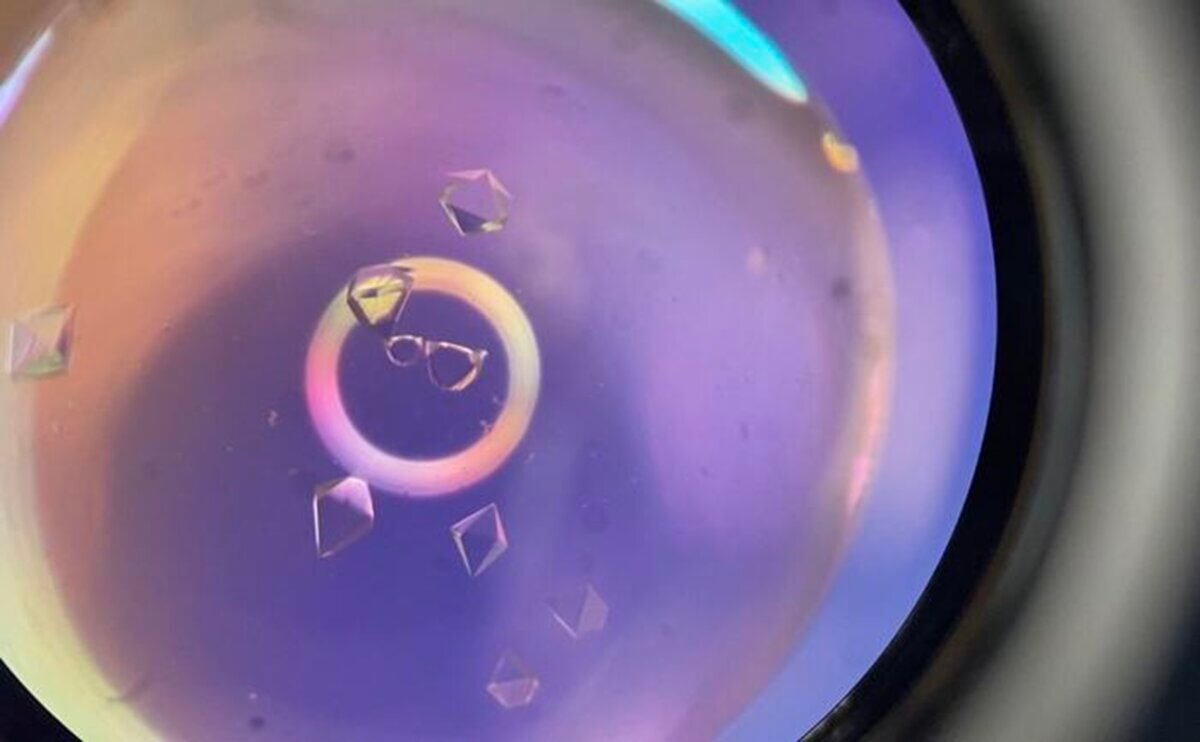
Researchers grew crystals of a pure actinium compound, seen here through a microscope, to understand how actinium binds to other molecules in a solid. (CREDIT: Jen Wacker/Berkeley Lab)
Researchers grew crystals containing actinium and illuminated them with X-rays to learn how the radioactive metal binds with other elements. That information could help design better cancer treatments.
The element actinium was first discovered at the turn of the 20th century, but even now, nearly 125 years later, researchers still don’t have a good grasp on the metal’s chemistry. That’s because actinium is only available in extremely small amounts and working with the radioactive material requires special facilities. But to improve emerging cancer treatments using actinium, researchers will need to better understand how the element binds with other molecules.
In a new study led by the Department of Energy’s Lawrence Berkeley National Laboratory (Berkeley Lab), researchers grew crystals containing actinium and studied the compound’s atomic structure. While elements often behave similarly to their lighter cousins on the periodic table, researchers were surprised to find that the actinium behaved differently than predicted by looking at its counterpart, lanthanum.
“There’s a breadth of applications for these elements, from nuclear energy to medicine to national security, but if we don’t know how they behave, that inhibits the progress we can make,” said Jen Wacker, first author of the paper published today in Nature Communications and a chemist at Berkeley Lab. “We’re seeing that this work is necessary to really understand the complexity of these radioactive elements, because in a lot of cases, using their surrogates is not sufficient to understand their chemistry.”
One area of interest is in using an isotope of actinium (actinium-225) in a cancer treatment method called targeted alpha therapy (TAT), which has shown promise in clinical trials. The TAT method uses biological delivery systems such as peptides or antibodies to move the radioactive element to the cancer site. When the actinium decays, it releases energetic particles that travel a short distance, destroying the nearby cancer cells but sparing healthy tissue further away.
“There’s a movement to design better delivery systems to get the actinium to particular cells and keep it there,” said Rebecca Abergel, a UC Berkeley associate professor of nuclear engineering and of chemistry who leads the Heavy Element Chemistry Group at Berkeley Lab. “If we can engineer proteins to bind the actinium with a really high affinity, and either be fused with an antibody or serve as the targeting protein, that would really enable new ways to develop radiopharmaceuticals.”
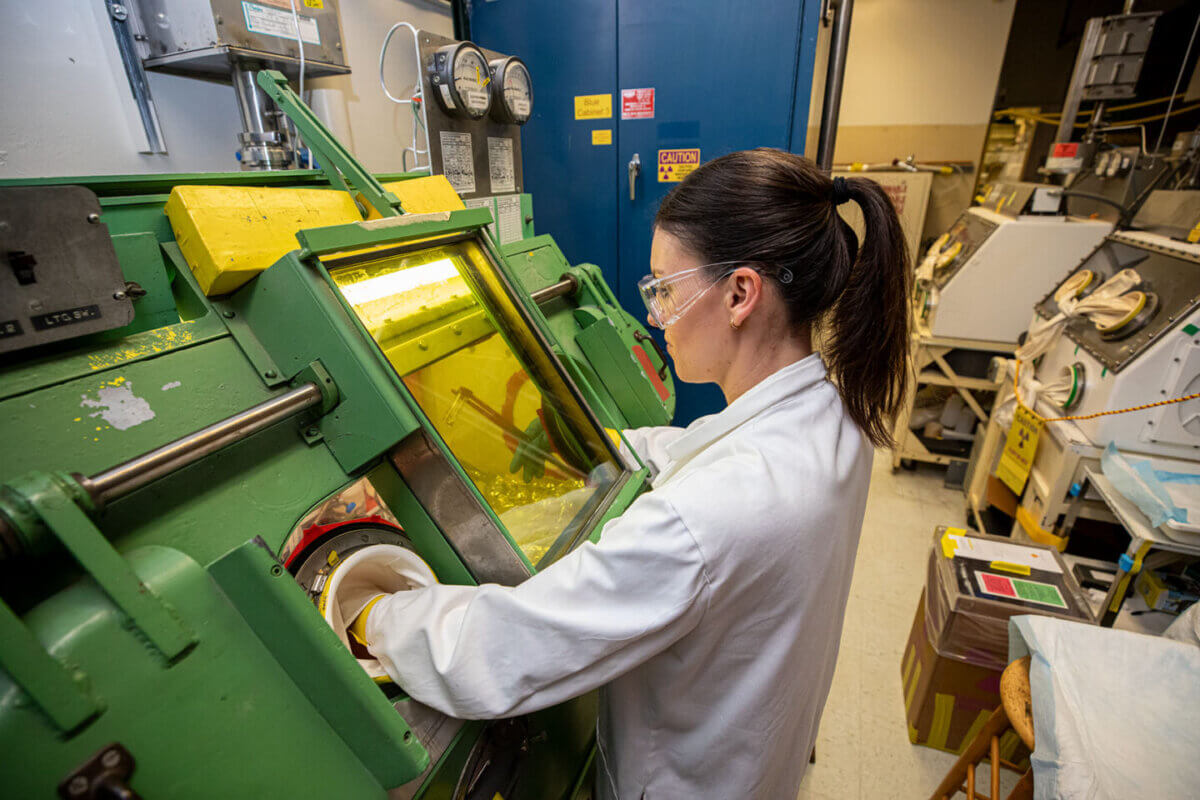
Researchers used a novel approach to grow the crystals using only 5 micrograms of pure actinium – roughly one tenth the weight of a grain of salt, and invisible to the naked eye. They first purified the actinium through a complex filtration process that removed other elements and chemical impurities. They then bound the actinium to a metal-trapping molecule called a ligand and enveloped the bundle inside of a protein isolated and purified by Roland Strong’s team at the Fred Hutchinson Cancer Center, building a “macromolecular scaffold.” The crystals, grown over a week inside of the Heavy Element Research Laboratory, were then cryocooled in liquid nitrogen and illuminated with X-rays at Berkeley Lab’s Advanced Light Source (ALS). The X-rays revealed the compound’s 3D structure and showed how actinium interacted with surrounding atoms. It is the first single-crystal X-ray structure reported for actinium.
“I’ve been working in crystallography for 40 years and seen a lot of things, and the method the team is using is unique and provides details we couldn’t get in the past,” said Marc Allaire, a scientist in Berkeley Lab’s Molecular Biophysics and Integrated Bioimaging Division and head of the Berkeley Center for Structural Biology team at the ALS. “To the best of my knowledge, Berkeley Lab is the only place in the world where we do this kind of study and measure radioactive protein crystals.”
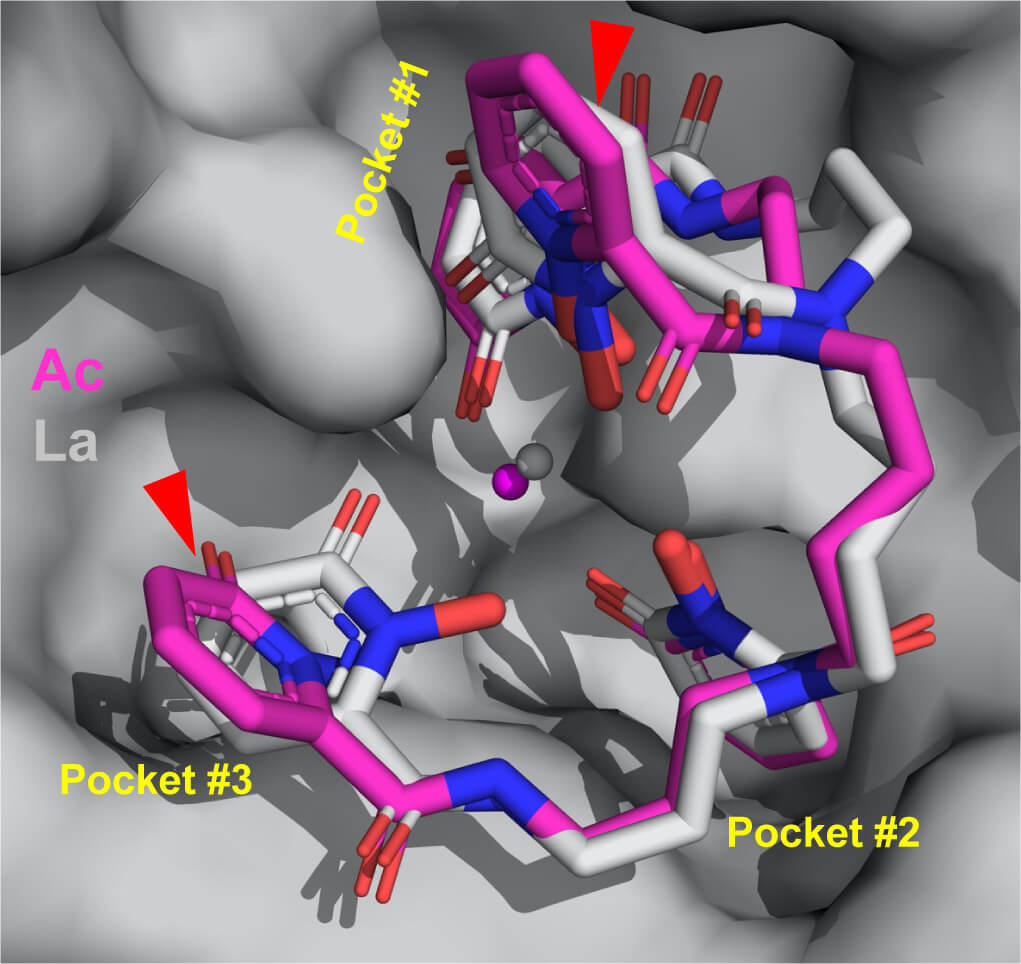
In this work, scientists used actinium-227, the longest-lived isotope of the element. Future studies will explore actinium-225 (the preferred isotope for targeted alpha therapy) to look for other changes in how the metal binds. Researchers are also interested in pairing actinium with different proteins to learn more about the structures it forms.
“This is very fundamental science that is part of our core program in understanding the chemistry of heavy elements,” Abergel said. “We’ve achieved a really technically difficult experimental method that pushes the boundaries of isotope chemistry and lets us gain a better understanding of this element. It hopefully will enable us and others to develop better systems that are useful for targeted alpha therapy.”
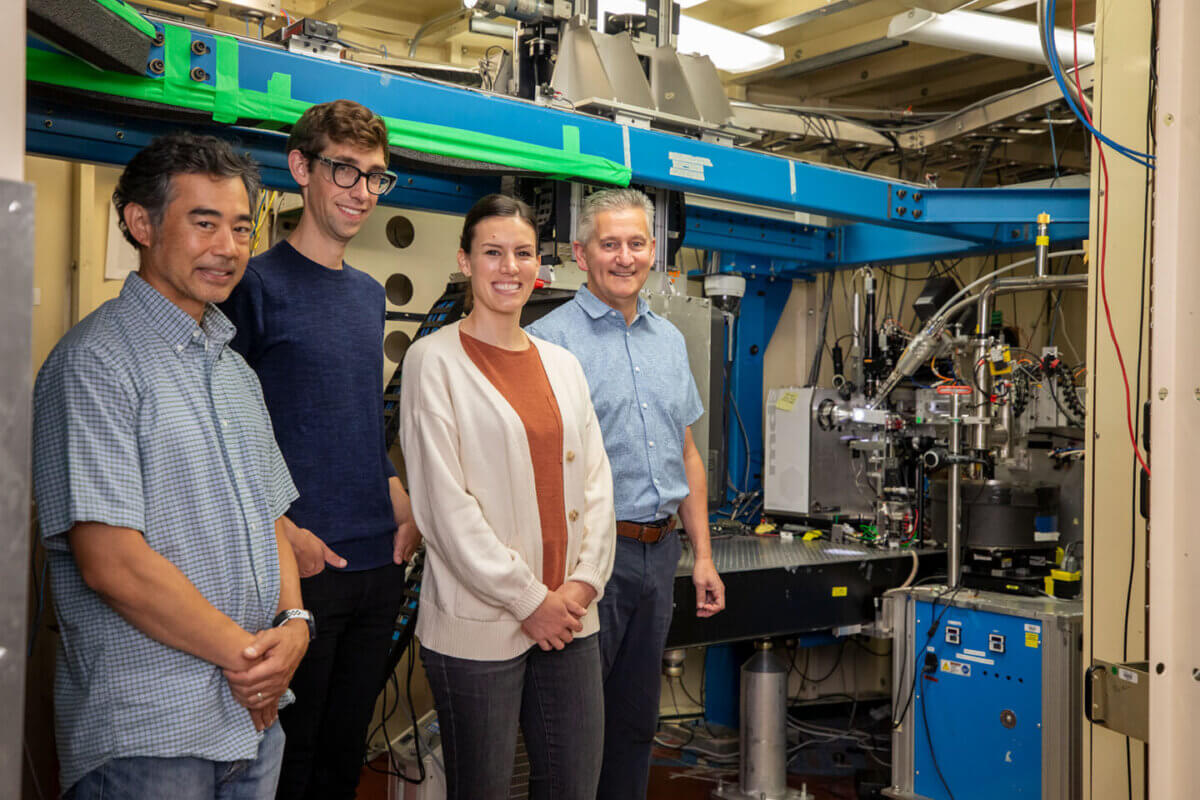
The Advanced Light Source is a DOE Office of Science user facility.
Press release provided by the Lawrence Berkeley National Laboratory
The paper, “Actinium chelation and crystallization in a macromolecular scaffold,” is published in Nature Communications.


