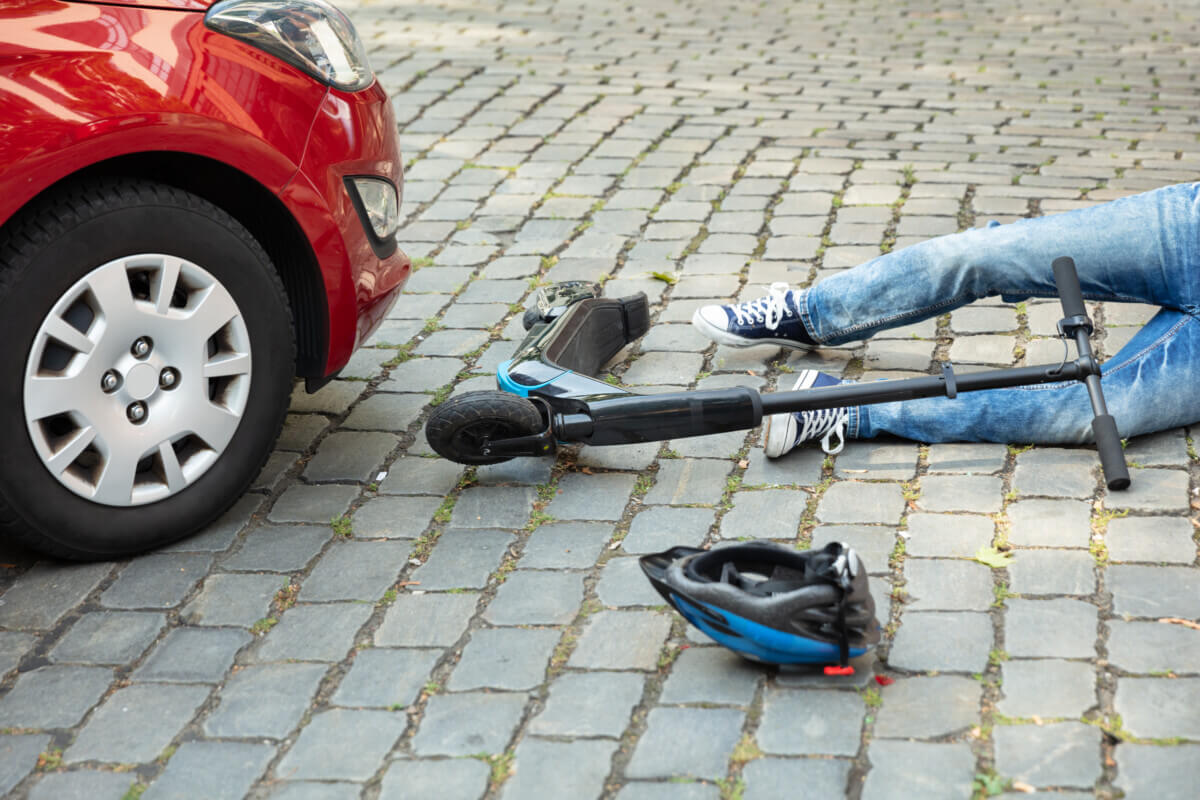
Man After Accident On Electric Scooter Overrun By Car (© Andrey Popov - stock.adobe.com)
???? Key Findings:
- The design of a neighborhood may be key to who caused an accident
- Pedestrians are found at fault more often in areas with few crosswalks and signals
- Drivers are found at fault more often in areas with pedestrian-friendly designs
COLUMBUS, Ohio — Who is truly at fault in car-pedestrian accidents? A new study by a team at The Ohio State University reveals that it comes down to urban design. The research sheds light on how the built environment, particularly road types and the availability of marked crosswalks, plays a crucial role in determining who gets blamed when accidents happen.
Researchers analyzed five years of data on pedestrian crashes in Franklin County, Ohio. Out of 2,757 pedestrian crashes recorded between 2015 and 2019, drivers were found at fault in 54 percent of the cases, while pedestrians were blamed in 36 percent of accidents. The study points out that pedestrians are more likely to be held responsible in areas with high traffic, faster-moving vehicles, and a scarcity of crosswalks.
“Our findings suggest that while the tendency is to blame individuals, the built environment where the crash occurs plays an important role,” says study author Jonathan Stiles, who led the study as a postdoctoral researcher in geography at Ohio State and is currently a visiting assistant professor at Columbia University, in a media release.
This assertion is backed by the observation that in downtown Columbus, where pedestrian infrastructure is more developed, drivers are more frequently found at fault.
Researchers also highlighted the disparity in assessing blame in different neighborhoods. In downtown Columbus, with its pedestrian-friendly design, drivers were at fault in three out of four crashes, compared to only 17 percent of accidents where pedestrians were blamed. In the lower-income neighborhoods of Hilltop and South Linden, however, pedestrians found it more challenging to navigate safely due to the infrequency of crosswalks with signals. In Hilltop, the fault was evenly split between pedestrians and drivers, while in South Linden, pedestrians were found at fault in 55 percent of crashes.

Researchers point out that arterial roads — high-capacity thoroughfares designed to deliver traffic from collector roads to freeways — pose significant risks to pedestrians. These roads often lack sufficient pedestrian crossing points, increasing the likelihood of pedestrians being blamed for accidents. The presence of bus stops along these roads exacerbates the problem, as dropped-off passengers might have to cross busy roads with minimal crossing facilities available.
The study’s findings emphasize the need for a rethink in road design and urban planning to enhance pedestrian safety. Researchers suggest incorporating details of the built environment into crash report forms filled out by police. This would provide a clearer context for pedestrian behavior, moving beyond the simplistic assignment of fault based on immediate circumstances.
Study co-author Harvey Miller, professor of geography at Ohio State and director of the Center for Urban and Regional Analysis, advocates for a Safe System Approach in urban design. This approach prioritizes minimizing the impact of human errors and ensuring that streets are safe for both pedestrians and vehicles.
“We don’t have to design the streets the way we do. We can make fundamental design choices that could prioritize safety over the speed of traffic,” notes Miller.
The study not only calls for more pedestrian-friendly infrastructure but also aligns with Vision Zero Columbus, a city initiative aimed at reducing traffic-related deaths and injuries. By highlighting the influence of urban design on pedestrian safety, the research underscores the importance of creating environments where pedestrians and drivers can coexist safely, reducing the likelihood of accidents and the consequent blame game.
The study is published in the Journal of Transport and Land Use.


