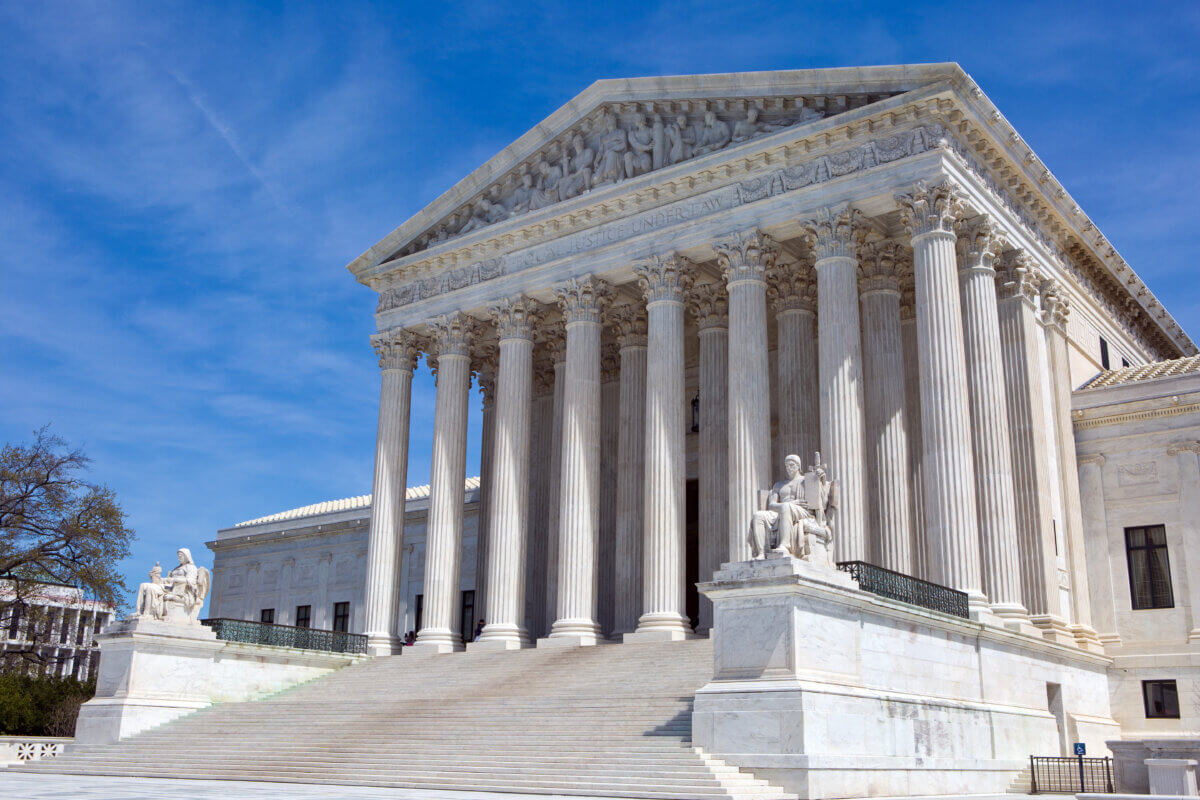
United States Supreme Court building in Washington, D.C. (Credit: Steven Frame on Shutterstock)
An AI Model Found the Justices Who Soften Their Dissents With a Compliment First
In A Nutshell
- Researchers built an AI tool that scans Supreme Court dissents and concurrences for “concessions,” moments when a justice compliments the majority’s reasoning even while disagreeing with the outcome.
- The model analyzed 9,049 opinions written between 1946 and 2011, and a human check confirmed it was reliably catching the real thing.
- Justices at the ideological extremes conceded less to the majority than justices closer to the center did.
- Larger, more ideologically mixed majorities tended to get more conciliatory language from the justices who disagreed with them.
Supreme Court justices are supposed to be careful, measured writers. A new study reveals a pattern hiding inside their opinions: some justices routinely compliment their opponents’ reasoning even while tearing it apart, and researchers built a machine learning tool that can detect this pattern across decades of legal writing.
Donald Snyder and Caitlyn Pierce, political scientists at the University of Massachusetts Amherst, call it an “appeasement” measure. It tracks moments when a justice writing a dissent or concurrence acknowledges the majority got something right, even while arguing the majority reached the wrong conclusion. Published in American Politics Research, the study finds this on-paper courtesy isn’t random. Certain justices, and certain moments in a case’s history, produce more of it than others.
Consider two responses to Dobbs v. Jackson Women’s Health Organization (2022). Justices Breyer, Sotomayor, and Kagan wrote a blistering joint dissent, calling the majority’s historical analysis “window dressing.” Chief Justice Roberts, writing separately, called the majority’s reasoning “thoughtful and thorough,” agreeing prior precedent should be discarded while arguing the majority went further than necessary. Both disagreed with the outcome. Only one complimented the other side first.
An AI Model Sorted 60,000 Passages Into ‘Concessions’ and Not
Measuring rhetorical courtesy across decades of legal writing isn’t something a researcher could easily do by hand. Snyder and Pierce turned to LEGAL-BERT, an AI model trained on legal text, to scan 9,049 dissents and concurrences written between 1946 and 2011, pulling every passage where a justice directly addressed “the Court” or “the majority.” That search turned up 60,637 passages.
Researchers hand-labeled a sample of those passages as either a “concession” (the justice grants the majority has a point) or a “non-concession” (no ground given), and a second reader checked the work, agreeing with the labels 97% of the time, confirming people could reliably spot the pattern. The AI model, once trained on those examples, got just as good at it, correctly catching real concessions over 90% of the time and landing above 98% overall accuracy on cases it had never seen.
Each justice’s appeasement score, whether for a single opinion or a whole career, comes down to how often they conceded versus how often they didn’t.

‘Wild Bill’ Douglas Scored Lowest, Rehnquist Changed After Becoming Chief
Some findings match reputations Court watchers already knew. Justice William O. Douglas, nicknamed “Wild Bill,” was a prolific opinion writer known for blunt disagreement. His appeasement scores ranked consistently among the lowest in the dataset.
Justice William Rehnquist showed a different trajectory. As an Associate Justice, his scores stayed fairly stable. After his 1986 promotion to Chief Justice, his scores grew more variable but reached new highs, a shift researchers see as possibly tied to his stake in protecting the Court’s legitimacy, though the paper stops short of calling it proven.
At the case level, Justice William Brennan’s 1976 dissent in Francis v. Henderson, the furthest-left justice on the Court that year by the study’s measure, ranked among the lowest appeasement scores recorded. The case involved a petitioner protesting the exclusion of African Americans from the grand jury that indicted him, and Brennan’s dissent offered sharp condemnation with little rhetorical softening.
Justice Harry Blackmun’s concurrence in the 1980 case United States v. Ward, a technical dispute over environmental penalties, scored on the opposite end. Researchers suggest the subject matter may have left room for measured, cooperative language.
Justices at the Ideological Extremes Conceded the Least
A central finding involves ideology. Justices at the ideological extremes conceded less to the majority, while justices closer to the center conceded more, using a standard political science measure that places justices on a spectrum from liberal to conservative. A separate measure that tracks harsh or emotional language showed no such pattern, suggesting something specific: extreme justices aren’t necessarily angrier on the page, they’re just less willing to hand the other side any credit at all.
Coalition size mattered too. As the majority grew larger and more diverse, dissenting justices tended to write more conciliatory language, perhaps because a broader coalition is harder to argue against.
Kavanaugh Says He Writes With the Losing Side in Mind
Snyder and Pierce argue the tool extends beyond legal scholarship. Congressional floor debates and campaign rhetoric involve the same choice: whether to validate any part of an opponent’s argument or reject it outright. During a 2023 Notre Dame Law Review symposium, Justice Brett Kavanaugh described writing with multiple audiences in mind, including the losing party. “I want them to read it and say, ‘Well, okay. They at least treated our arguments with respect and fairly,'” Kavanaugh said.
This appeasement measure offers one way to track how justices frame disagreement in print. It does not show whether conciliatory language improves relationships or strengthens the Court itself. What it does show is that some justices reach for a compliment before delivering a rebuttal, a choice that follows real patterns.
Disclaimer: This article summarizes findings from a peer-reviewed study and is intended for general informational purposes. It does not represent legal advice or an official interpretation of any court ruling.
Paper Notes
Limitations
The study’s data is limited to Supreme Court opinions from 1946 to 2011, a constraint the authors attribute to the boundaries of their accessible opinion-text database. Opinions published before this window are not included, and the authors note that earlier eras of the Court were generally understood to suppress outward disagreement publicly. Additionally, the measure is built specifically around non-majority opinions, meaning concurrences and dissents, and the authors do not claim it reflects how a justice approaches legal reasoning more broadly. Because many people may contribute to the drafting of a non-majority opinion, the measure is attributed to the justice who signed off on the final version rather than to any specific drafter. The authors also note that because their analysis focuses on published opinions only, some data was necessarily excluded.
Funding and Disclosures
According to the paper, the authors received no financial support for the research, authorship, or publication of this article. No conflicts of interest were declared.
Publication Details
Authors: Donald Snyder and Caitlyn Pierce, Department of Political Science, University of Massachusetts Amherst | Paper Title: Measuring Judicial Appeasement of the United States Supreme Court | Journal: American Politics Research, 2026, Vol. 0(0), pp. 1–15 | DOI: 10.1177/1532673X261462118 | Data Availability: The dataset used in the study has been made publicly available at https://osf.io/qkahw/


